
Does gamified sales training actually work, and what does it look like?
The short answer
Yes, but not because points and leaderboards are fun. It works because retrieval practice under time pressure, with immediate feedback on why an answer was right, builds durable skill faster than passive training. A 2020 meta-analysis of 38 studies found gamified instruction raised cognitive learning outcomes with an effect size of g=0.49 over non-gamified formats.
Does the evidence actually hold up?
The honest answer is mixed-but-positive, and the mechanism matters more than the label "gamified." Sailer and Homner's 2020 meta-analysis of 38 studies found gamified instruction produced a moderate effect size (g=0.49) on cognitive learning outcomes compared to non-gamified versions of the same content. That's a real, replicated effect — but it's driven by specific design choices, not by slapping a scoreboard on a slide deck. The underlying cognitive-science finding is older: Roediger and Karpicke's 2006 retrieval-practice research showed that testing yourself on material, especially repeatedly and under some pressure, produces far better long-term retention than rereading or passive review. Games are just a wrapper that makes people willingly do more retrieval practice than they'd otherwise tolerate. A TalentLMS survey of workers found 89% reported gamification made them more productive and 88% said it made them happier at work — which matters for adoption, since the best-designed training program fails if reps skip it.
The failure mode is real too: badges and leaderboards bolted onto a traditional course with no change to the actual practice mechanic show much weaker effects in the same meta-analysis. The game has to force retrieval, not just reward completion.
What it actually looks like for a sales objection
In practice, effective gamified objection training looks less like a quiz and more like a fast-paced arcade round: a prospect objection appears as a provocation, the rep has a handful of seconds to pick the right counter from several options, and a round has a fixed number of moves rather than running until someone quits.
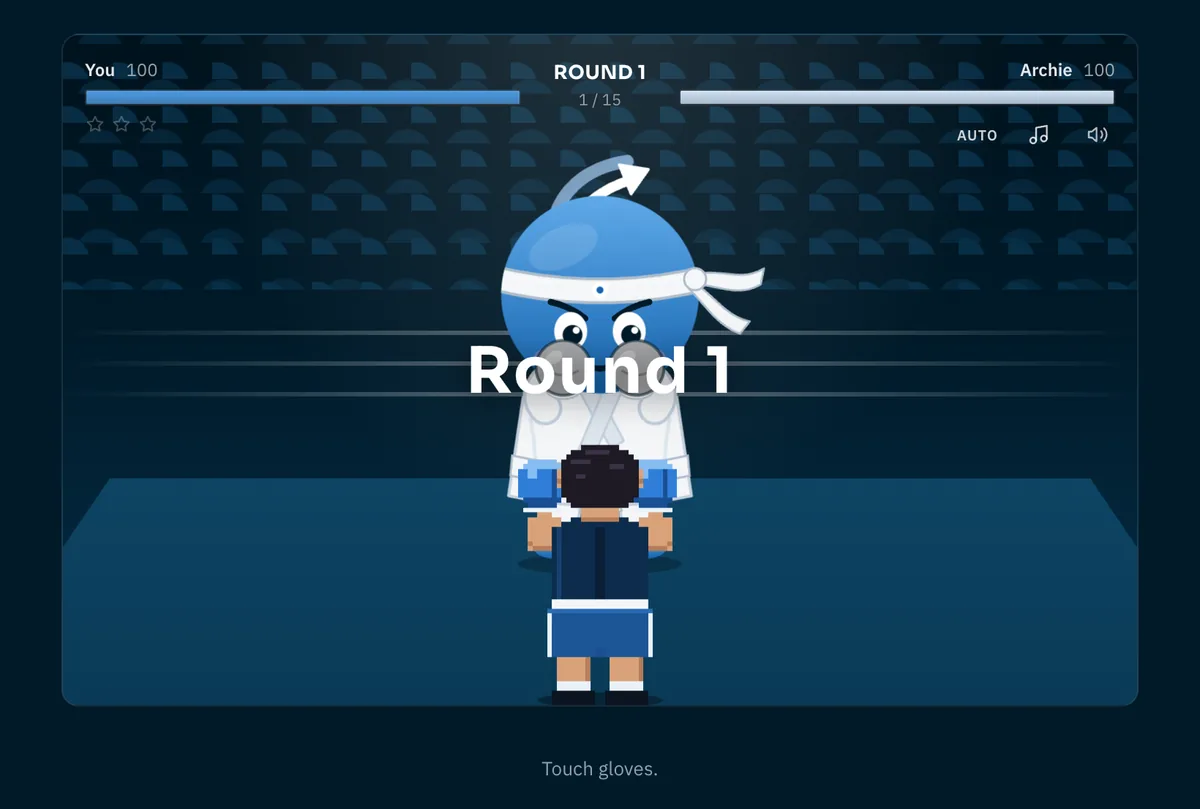
The time pressure isn't decoration — it mimics the actual conditions of a live call, where a rep has a couple of seconds to respond before the silence gets awkward, and it's the mechanism that forces the brain to retrieve the answer rather than recognize it from a list.
Why the feedback matters more than the score
The part most gamified training skips is the explanation. A system that tells a rep "correct" or "+10 points" teaches almost nothing; a system that explains why a particular counter beat a particular objection — what principle it applied, why the alternative would have lost the prospect — is doing the actual teaching. This is also where Roediger and Karpicke's findings apply most directly: the learning gain from retrieval practice is strongest when it's followed by corrective feedback, not when it's graded silently.
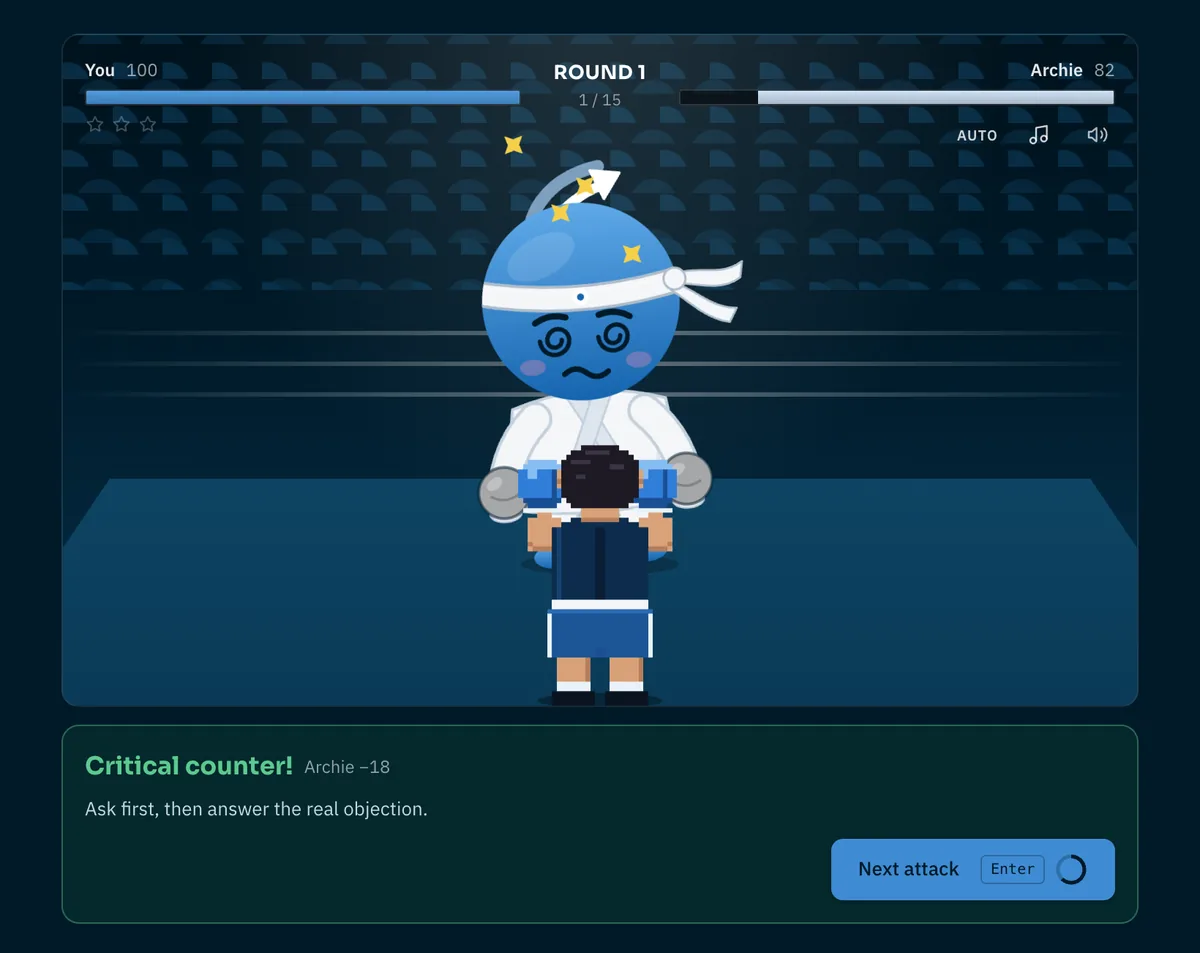
A well-built drill also varies the objections enough that reps can't memorize a sequence, tracks streaks so the system knows which objection types a given rep hasn't mastered yet, and keeps rounds short enough that reps will actually do five or six in a sitting rather than one and never again.
What gamification can't fix
It's worth being straight about the limits. Gamified drilling builds fluency with known objections and known plays — it does not substitute for discovery skill, deal strategy, or the judgment to know which play applies to a messy, ambiguous real deal. The Sailer and Homner effect size, while real, is moderate, not transformative; it buys faster and stickier skill acquisition on well-defined tasks, not a replacement for coaching on live calls. Treat it as the repetition layer underneath manager coaching, not instead of it.
Where SalesARC fits
SalesARC University includes Fight Archie, an arcade-style drill built on exactly this mechanic — timed rounds, mapped counter choices, and feedback that explains the reasoning behind each win, not just the outcome — alongside comic-format lessons and short knowledge checks. It's priced as a flat $349 monthly subscription with extra seats at $39 monthly, intended as the practice layer that sits under whatever coaching or playbook structure a sales team already has, not a replacement for it. More at SalesARC University.