
How do I know if my sales training actually worked, beyond a quiz at the end?
The short answer
A quiz measures recall, not performance. Use Kirkpatrick's Level 3 and 4: did objection-handling win rate rise on live calls, did discovery notes start capturing quantified pain, did ramp time to first closed deal shrink. Pull this from call recordings and CRM fields 30 to 60 days after training, not from a test score taken the day it ends.
A quiz tells you whether someone paid attention for twenty minutes. It does not tell you whether they can handle a real procurement objection at minute thirty-eight of a live call, under time pressure, with a prospect who's already compared you to two other vendors. Most sales training programs stop measuring at exactly the point where it stops mattering.
The four levels, and why most companies only measure one
Donald Kirkpatrick's training evaluation model, still the standard reference in corporate learning, breaks evaluation into four levels: Reaction (did they like it), Learning (did they absorb it, which is what a quiz checks), Behavior (did it change what they do on the job), and Results (did it move a business number). Most sales training vendors sell you Level 1 and Level 2 and call it done, because those are the easiest to measure and the easiest to make look good.
| Level | What it measures | How you'd actually check it |
|---|---|---|
| 1. Reaction | Did reps enjoy the training | Post-session survey score |
| 2. Learning | Did they retain the content | Quiz or knowledge check |
| 3. Behavior | Did it change call behavior | Call recording review, scorecard adherence |
| 4. Results | Did it move a business metric | Win rate, ramp time, deal size, 30-60 days out |
If your training program has never produced a Level 3 or Level 4 number, you don't actually know if it worked. You know people passed a test.
What to track instead of a final score
Three things are far more honest signals than a quiz, and all three are things you can pull from a CRM and a handful of call recordings without buying new software.
First, objection-handling win rate by objection type. If training covered price pushback and incumbent-vendor loyalty, tag closed-lost reasons for 60 days before and after training and compare. A real improvement shows up as a shift in win rate on calls where that specific objection appeared, not an overall bump that could be noise.
Second, discovery call quality. Pull a sample of call recordings or notes and check for the things training was supposed to teach: did the rep quantify the cost of the problem, did they get a number or a timeline, did they avoid pitching before discovery was done. This is a rubric, not a vibe check, and it should be scored by someone other than the rep.
Third, ramp time to first closed deal for new hires who went through the program versus those who didn't, or versus the prior cohort. If training is working, new reps should be closing their first deal faster, not just scoring higher on day-five tests.
Practice that generates evidence, not just a pass mark
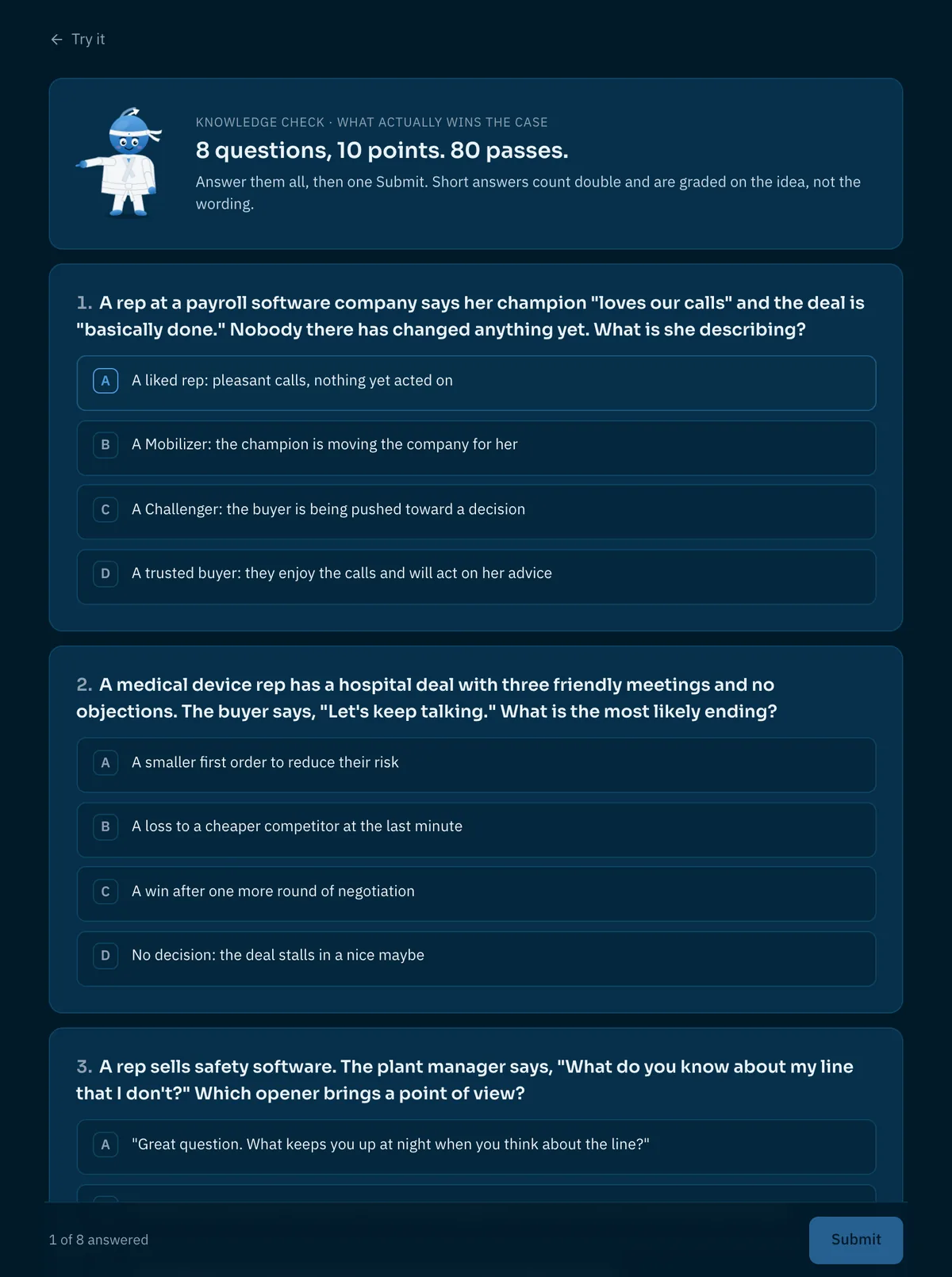
The reason most training can't answer "did it work" is that it was built to produce a pass/fail number, not evidence of behavior change. A knowledge check that grades short answers on the idea rather than exact wording, with a real pass mark and shuffled questions, at least tells you retention is real rather than memorized order. That's a necessary floor, but it's still Level 2.
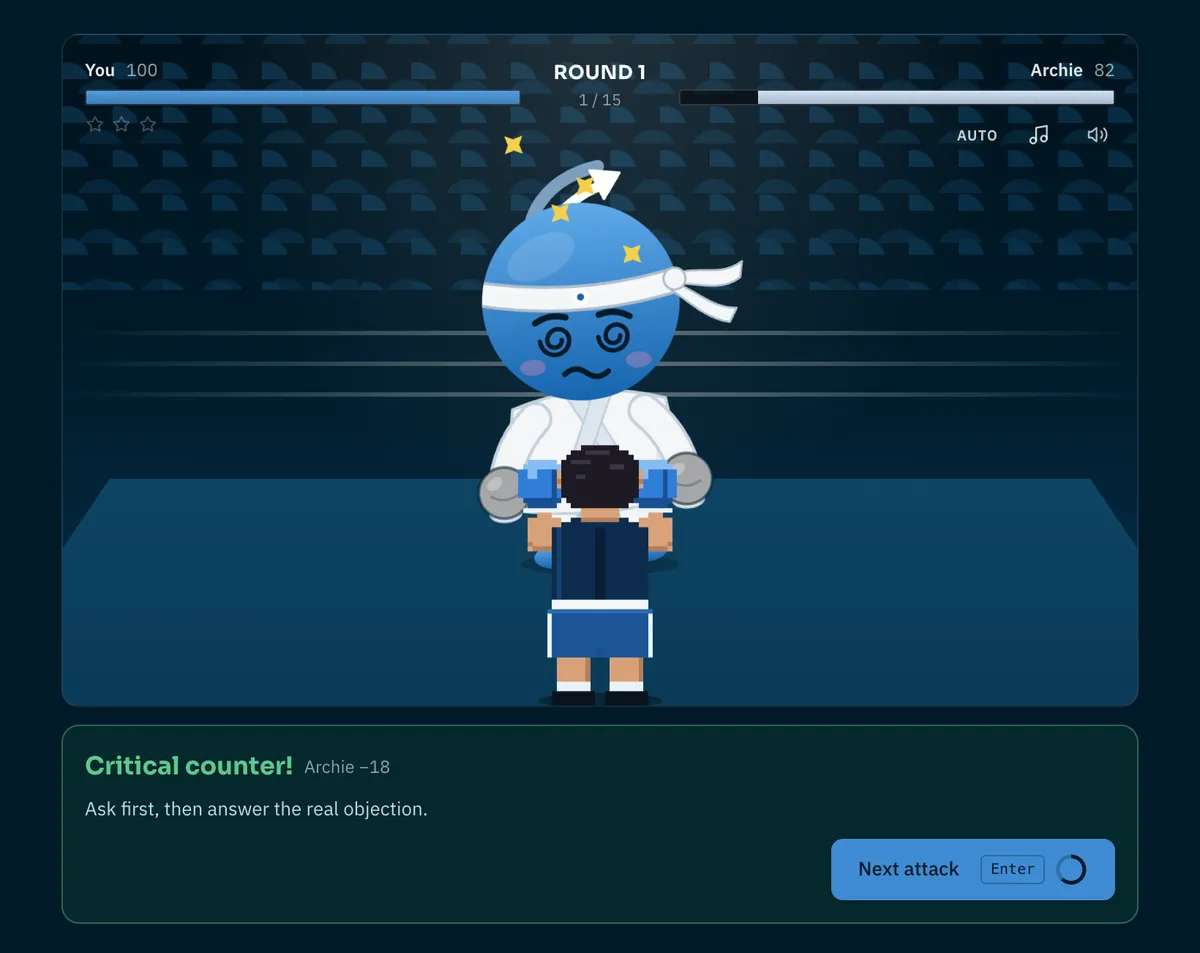
The more useful evidence comes from rehearsal that mirrors the pressure of a real call and scores the reasoning, not just the outcome. Objection-handling drills that explain why a counter won, not only that it did, give you a record of how a rep thinks under pressure, which is closer to a Level 3 behavior signal than any multiple-choice test.
Where SalesARC fits
SalesARC University is built around this gap: comic-style lessons and knowledge checks establish retention, and a rehearsal arcade (Fight Archie) drills objection handling under time pressure with feedback on reasoning, not just a score. It runs at $349 a month with extra seats at $39 a month. It won't hand you a Level 4 number automatically, that still requires pulling your own CRM and call data before and after, but it generates the Level 2 and Level 3 evidence most training programs never produce in the first place. See /product/university.
Related questions
- How long should it realistically take before a new sales hire or sales system starts producing real pipeline?
- What should a weekly sales report actually include so I can tell if my team is making real progress, not just staying busy?
- How do I build a sales playbook for a small company?
- What does a healthy sales pipeline look like for a company under $10M in revenue?