
What is Gap Selling and how do I teach my team to run discovery with it?
The short answer
Gap Selling, developed by Keenan, trains reps to quantify the distance between a prospect's current state and future state before pitching anything. Teach it with role-play, not a book club: reps need 10-15 scored discovery calls, live or simulated, before the three gaps (physical, business, personal) show up naturally in their questions.
What Gap Selling actually is
Gap Selling is a discovery methodology from Keenan's 2018 book "Gap Selling: Getting the Customer to Yes." The core claim is that most reps pitch too early because they never fully diagnose the problem — they ask surface questions, hear enough to pattern-match to a feature, and jump to the solution. Keenan's framework forces reps to build out two pictures before they're allowed to talk about their product: the prospect's current state (what's broken, and how they know it's broken) and their future state (what "fixed" looks like, in the prospect's own words, not the rep's). The sale is the gap between those two pictures, quantified in time, money, or risk.
The method borrows structure from solution selling and SPIN but pushes harder on root cause. Keenan separates three kinds of gaps a rep has to uncover: the physical gap (the literal operational problem — reports take six hours to compile), the business gap (the cost of that problem — six hours a week times a loaded rate times 52 weeks), and the personal gap (what it costs the specific person in the room — missed bonus, credibility with their boss, a promotion they're not getting). Reps who only find the physical gap end up competing on features. Reps who find all three end up with a champion who's selling the deal internally for you.
The three gaps, side by side
| Gap type | What it answers | Example question | Why it matters |
|---|---|---|---|
| Physical | What's literally broken today | "Walk me through how you build that report now." | Establishes the current state as fact, not assumption |
| Business | What the broken thing costs the company | "If this took half the time, what would that be worth annually?" | Gives you a number to build a business case around |
| Personal | What it costs the person you're talking to | "How does this affect your quarter, specifically?" | Creates the internal urgency that gets a deal prioritized over competing projects |
A discovery call that only produces a physical gap is a feature demo waiting to happen. A discovery call that produces all three gives you a champion with a personal reason to push the deal through procurement.
How to actually teach it
Handing reps the book doesn't change call behavior. Gap Selling is a skill, not a fact set, and skills come from repetition with feedback, not reading. A realistic rollout looks like this: one session to teach the three-gap framework and have reps map it to two or three real deals they're currently working. Then weekly call reviews where a manager or peer scores whether the rep found a physical, business, and personal gap — not whether the call "went well." Reps who skip straight to pitching should get stopped mid-roleplay and sent back to ask one more "why" question.
The hard part isn't the concept — it's catching the moment a rep is about to pitch too early, in real time, often on a live call where a manager isn't on mute ready to intervene. That's why most teams that successfully adopt Gap Selling build it into onboarding as a gated skill: a new rep doesn't get full pipeline responsibility until they've demonstrated the three-gap pattern on a set number of scored calls, usually somewhere between 10 and 15 based on how fast the rep is picking it up.
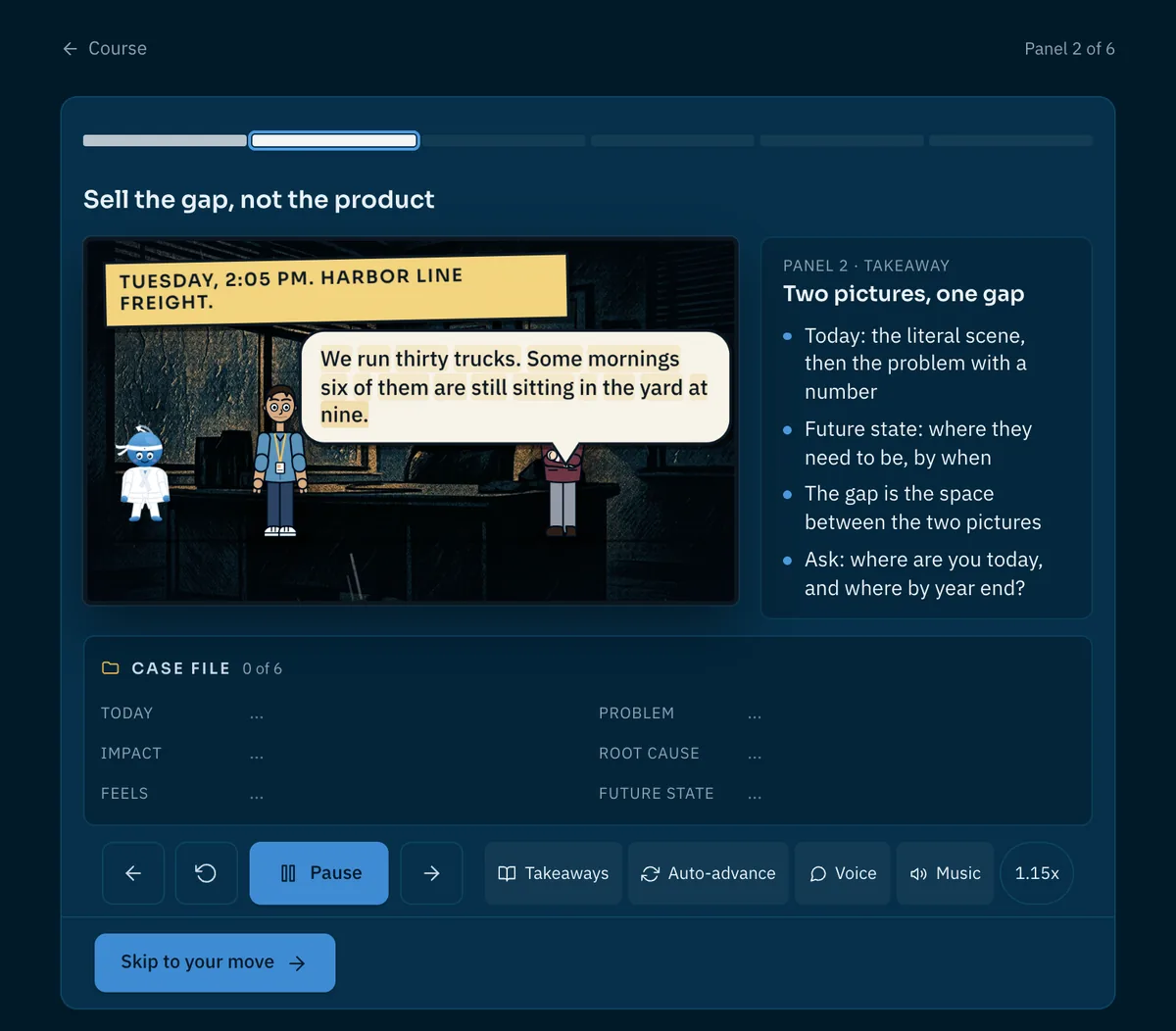
Rehearsal before live calls
The reason Gap Selling training often stalls is that it's hard to practice quantifying questions without a real prospect in front of you, and nobody wants a new rep's first attempt at root-cause questioning to happen on a real $40K deal. The fix is scenario-based rehearsal: the rep works a fictional account, asks the quantifying questions, and watches a case file fill in with today's state, the business impact, and the future state as they go — so they get the pattern-matching rep without burning a real prospect.
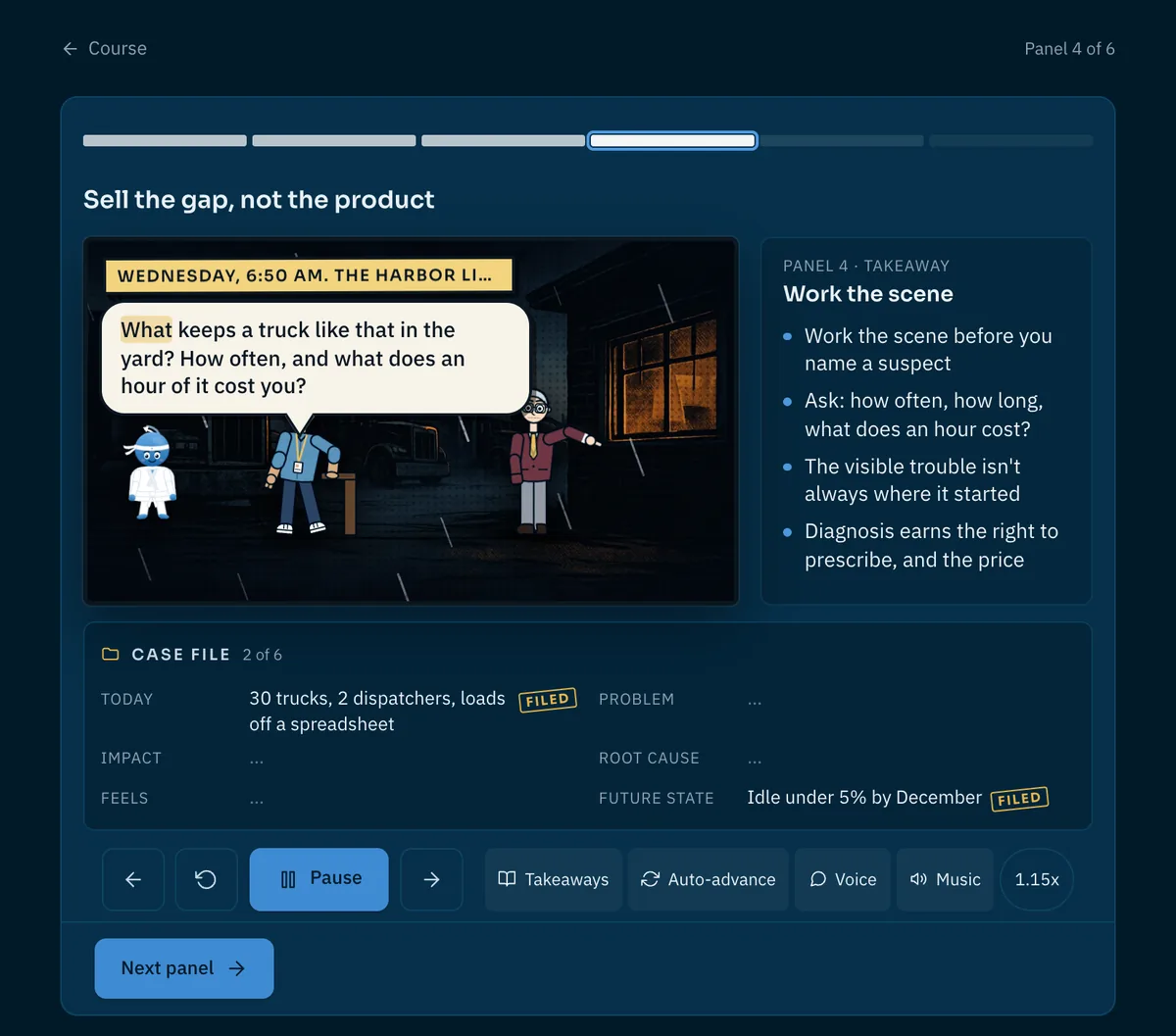
Where SalesARC fits
Gap Selling is a framework, not software — nothing replaces a manager who'll actually sit in on calls and coach the three gaps. Where SalesARC fits is the rehearsal gap most teams never close: SalesARC University teaches the discovery framework as a scenario-based lesson, then checks whether the rep can apply it before they're on a live call, at $349 a month with $39 per additional seat. It won't make the method stick on its own — call reviews and a manager willing to interrupt a bad discovery call still do most of the work.