
What is the Challenger Sale and how do I train my reps to sell that way?
The short answer
The Challenger Sale is a selling model from Matthew Dixon and Brent Adamson's CEB research identifying five rep profiles, with "Challengers" who teach, tailor, and take control outperforming relationship builders in complex B2B deals by a wide margin. Training reps requires teaching commercial insight, reframing customer thinking, and rehearsing the pushback that follows, not just memorizing a pitch.
What the Challenger Sale actually says
The Challenger Sale came out of research by Matthew Dixon and Brent Adamson at CEB, published in their 2011 book and summarized in a widely cited 2012 Harvard Business Review article. They studied thousands of B2B reps and sorted them into five profiles: Hard Worker, Relationship Builder, Lone Wolf, Reactive Problem Solver, and Challenger. In complex sales, Challengers made up 40% of top performers, while Relationship Builders — the profile most sales training optimizes for — made up only 7% of top performers in that same segment, according to the HBR summary of the research.
The core idea is uncomfortable for a lot of sales cultures: being well-liked doesn't close complex deals. Challengers win by teaching customers something new about their own business, tailoring that insight to the customer's specific situation, and being willing to apply constructive pressure — disagreeing with the customer's framing when it's wrong, even if it creates friction.
| Profile | Core behavior | Top performer share in complex sales |
|---|---|---|
| Challenger | Teaches, tailors, takes control | ~40% |
| Hard Worker | Grinds, follows up relentlessly | ~15% |
| Lone Wolf | Follows instinct, resists process | ~25%* |
| Reactive Problem Solver | Responsive, detail-oriented | ~10% |
| Relationship Builder | Builds rapport, avoids friction | ~7% |
*Lone Wolf numbers vary by source cut; directional figures per the original HBR summary of the CEB study.
Why this is hard to train
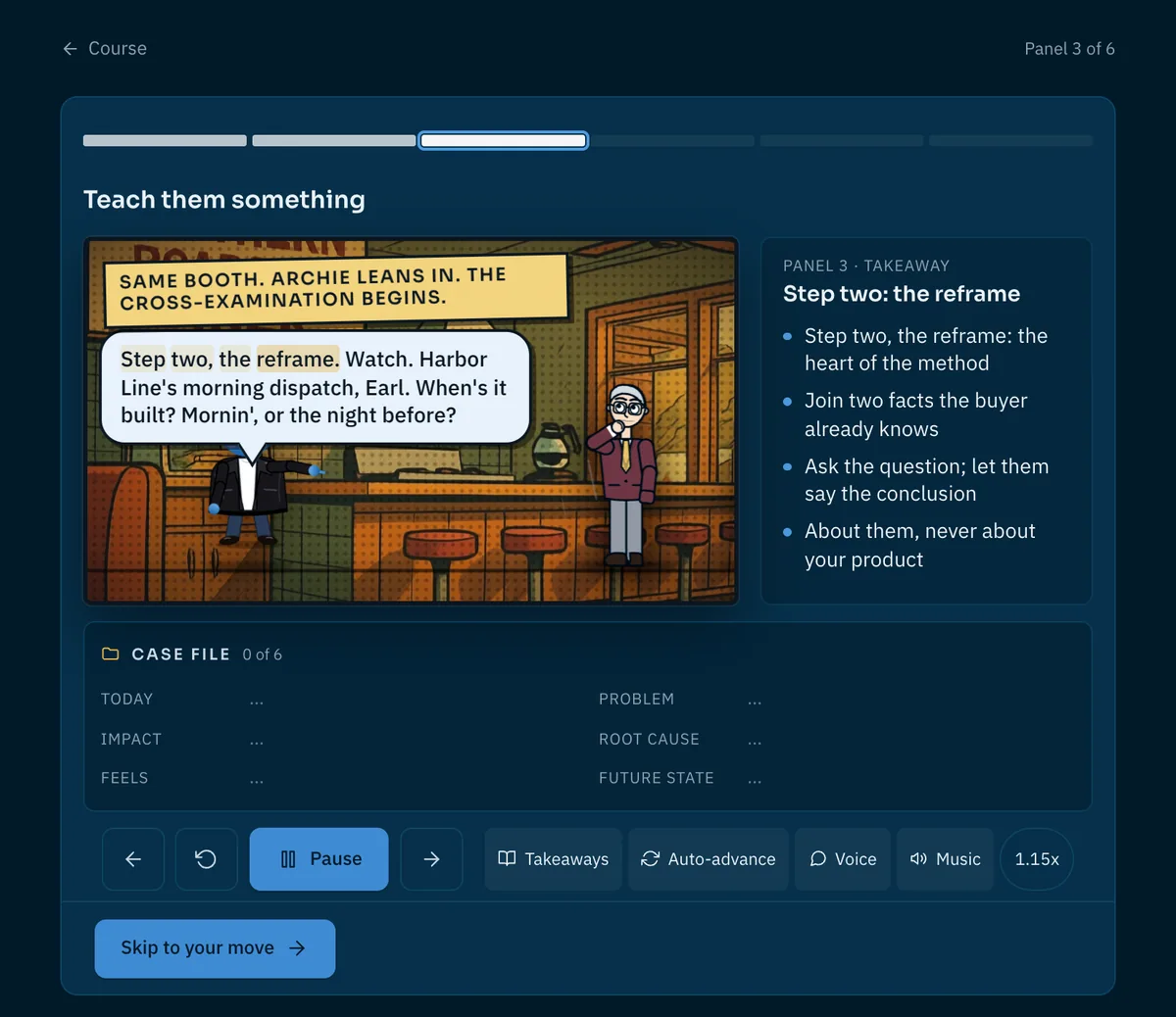
The uncomfortable part isn't the theory — it's the execution. Teaching a rep to "challenge" the customer without training the reframe sequence underneath it just produces reps who argue with prospects and lose deals. The actual skill is a structured sequence: warm up with something the customer already agrees with, reframe the problem using an insight they haven't considered, let the gap between their current approach and a better one sink in (sometimes called "rational drowning"), connect that gap to something that matters emotionally, then present the new way forward that leads naturally to your solution.
Most sales training stops at "here's our pitch deck." Challenger training has to teach a sequence, then force reps to practice it against real pushback, because the first time a prospect says "we're fine with our current vendor" is not the time for a rep to improvise.
Building the training program
A Challenger training rollout generally needs three layers. First, the commercial insight itself — the specific, defensible claim about what's costing the customer money or time that they haven't connected yet. This has to be built by whoever owns messaging, not improvised by reps on calls. Second, the teaching sequence — reps need to practice the warmer-reframe-drowning-impact-solution arc enough times that it stops sounding scripted. Third, objection rehearsal, because a Challenger approach invites more pushback than a relationship-building approach does, and reps who can't handle "that's not actually our biggest problem" will abandon the method the first time it gets uncomfortable.
The mistake most companies make is skipping straight to step three — running objection-handling drills without ever teaching the underlying insight or sequence. Reps end up good at deflecting pushback but with nothing substantive to reframe toward, which just produces confident reps saying nothing new.
Where SalesARC fits
SalesARC University teaches the Challenger sequence as a structured lesson — warmer, reframe, rational drowning, emotional impact, new way, solution — rather than as a slogan, and pairs it with scenario-based knowledge checks and an arcade-style objection drill called Fight Archie so reps rehearse the pushback before they hit it on a real call. It costs $349 monthly for the team plan, with extra seats at $39 monthly. It won't write your company's specific commercial insight for you — that still has to come from whoever owns product and market positioning — but it will stop your reps from learning the method only in theory. More at /product/university.