
How do I train new sales reps to handle objections without putting them on live calls first?
The short answer
Use a documented objection library tied to your specific product and buyer, then run reps through role-play against an AI voice agent or manager before any live call. Roth Capital and Gong research both tie documented objection handling to faster ramp. Budget 2-3 weeks of simulated reps before the first real prospect call.
The core problem: reps learn objections by losing deals
Most founder-led companies skip formal objection training because there's no manager to run it and no documented list of what prospects actually say. The result is new reps learning by failure — burning real leads while they find their footing. Gong's analysis of over 500,000 sales calls found that top performers handle objections differently from average reps not because they're naturally better talkers, but because they've internalized specific responses to specific pushback categories: price, timing, competitor comparison, and "need to think about it." That internalization has to happen somewhere before it happens on a paying prospect's phone call.
The fix isn't more hiring or more shadowing. It's building a documented objection library specific to your deal, then giving reps a safe environment to repeat responses until they're fluent — the same way pilots train in simulators before passengers board.
Build the objection library first
You can't train against objections you haven't written down. Pull the last 20-30 lost or stalled deals from your CRM or your own memory if you don't have one yet, and categorize what prospects actually said. In founder-led businesses this list is usually short: 8-12 recurring objections cover 80% of what comes up. Write the objection verbatim, then write two or three response variants — not a script to memorize, but a structure (acknowledge, reframe, proof point, question back) reps can adapt in their own voice.
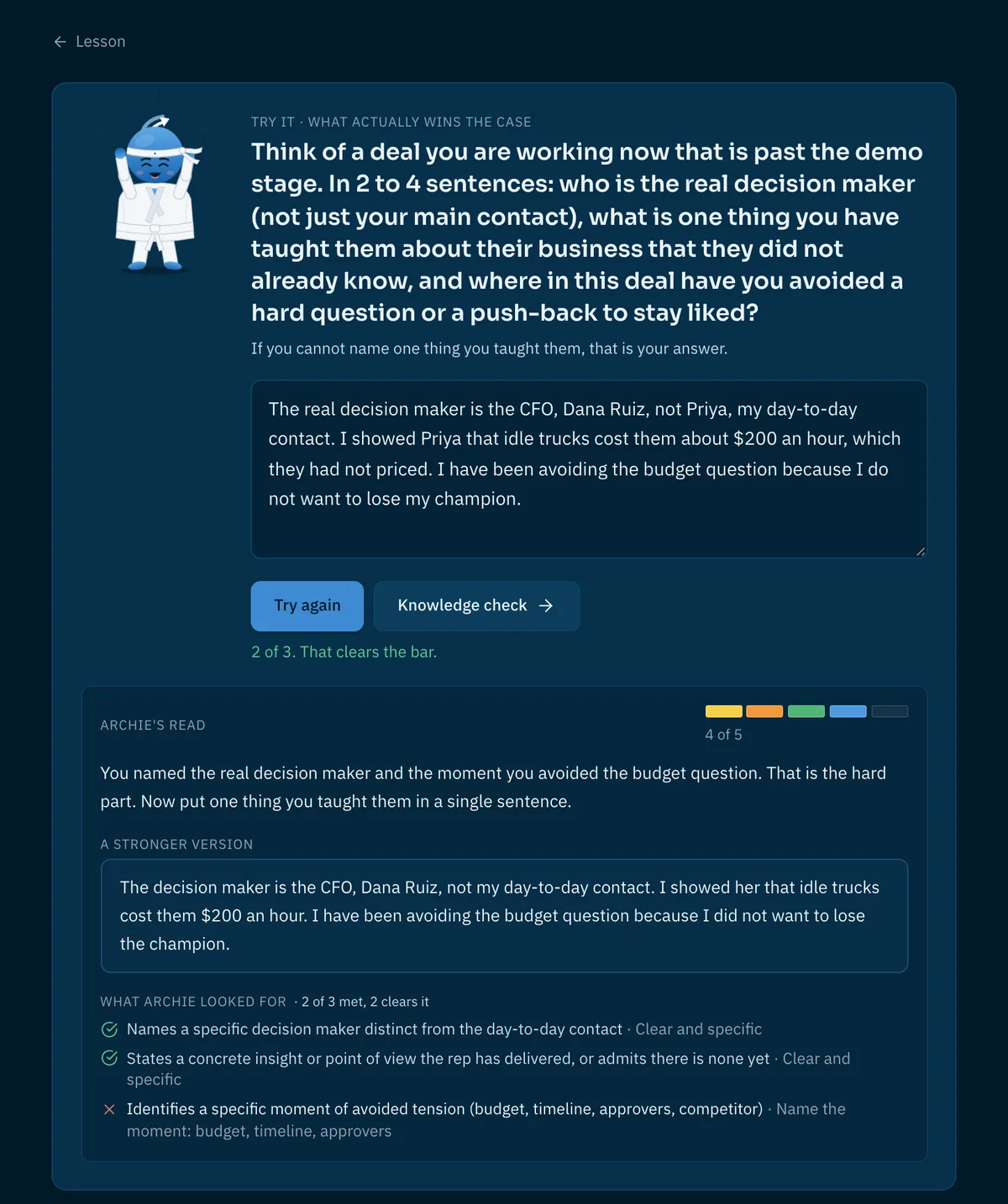
This step alone often reveals why deals stall. If "we need to check with our board" shows up on half your lost deals, that's not a rep skill problem — it's a sales process problem, meaning the rep is talking to the wrong person too early.
Simulate before you deploy
Once the library exists, reps need reps — repetitions, not calls. Three approaches work, in order of increasing realism:
| Method | What it does | Where it falls short |
|---|---|---|
| Written drills / flashcards | Reps memorize response structures | No tone, pacing, or pressure |
| Manager or peer role-play | Realistic pressure, immediate feedback | Expensive in manager time, inconsistent across reps |
| AI voice agent simulation | Unlimited repetitions, consistent objection delivery, scorable | Doesn't replicate human rapport dynamics perfectly |
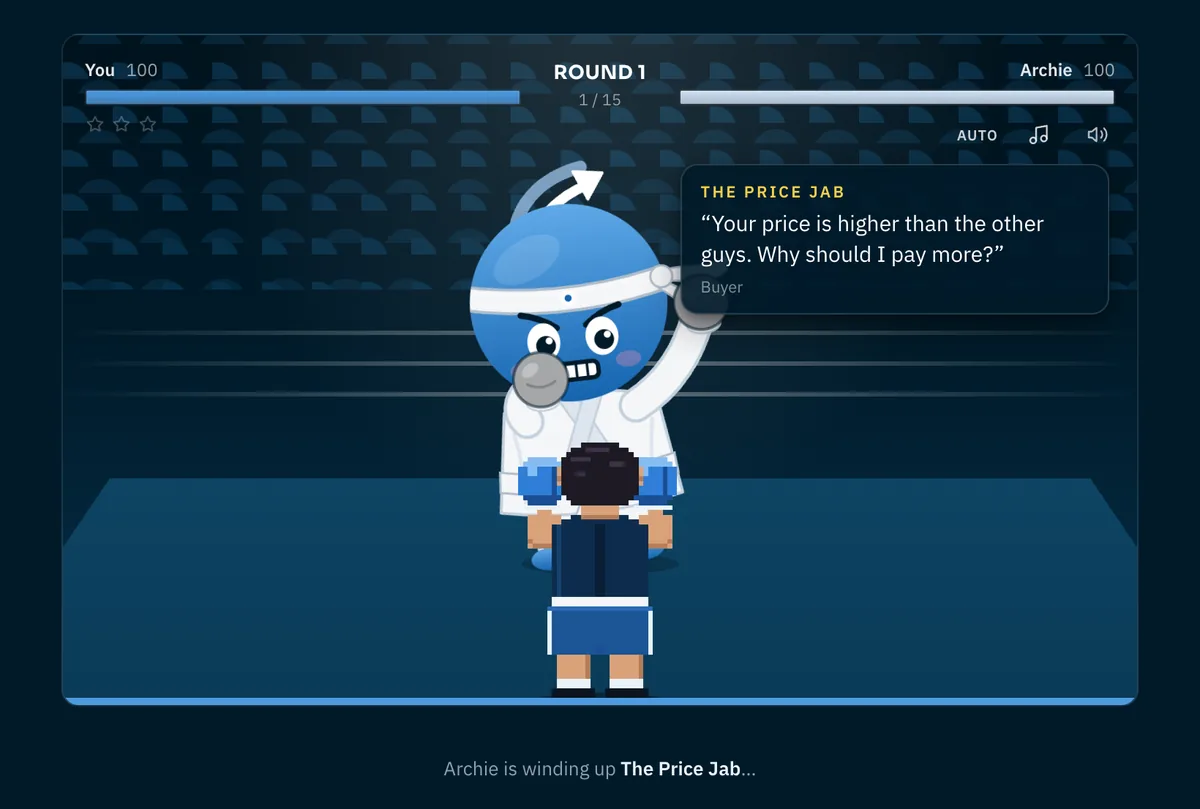
The AI voice agent route is underused but effective for ramp specifically because it removes the bottleneck of manager availability. A rep can run the same "your price is 30% higher than X" objection fifteen times in an afternoon, with a transcript afterward showing exactly where the response was strong or weak. SalesARC's AI voice agent, priced at $499 monthly for 1,000 minutes, can be configured to play difficult prospect personas for this kind of rehearsal — it's not its primary use case (that's inbound handling) but it's a legitimate secondary one for small teams without a sales manager to run role-play.
How long this should take
For a founder-led company hiring its first or second rep, a realistic ramp sequence looks like: week 1 product and ICP training, week 2 objection library review plus 15-20 simulated calls, week 3 shadowed live calls with the founder or manager present, week 4 first solo calls on lower-stakes leads. That's roughly three weeks before a rep is unsupervised on a real prospect — faster than the 60-90 day ramps common in larger sales orgs, because the deal complexity and objection set in a $5M-$15M ARR company is narrower than in enterprise sales.
Skipping the simulation step doesn't save time — it moves the learning curve onto real pipeline, which costs more in burned leads than the two weeks of rehearsal would have cost in payroll.
Where SalesARC fits
A documented objection library only works if it's written down and kept current, which is exactly what SalesARC Playbook builds — including the objection-handling section — for a one-time fee starting at $999. Teams that also want a structured rehearsal environment can layer in the AI voice agent for role-play before a rep's first live call. Neither replaces a manager watching real calls once reps go live, but both shrink the gap between "hired" and "trusted with a real prospect." See /product/playbook for details. SalesARC University adds Fight Archie, an arcade game that throws objections at a rep against a clock, and Try It exercises where Archie marks a written answer against a checklist.
Related questions
- How do I build a sales playbook for a small company?
- What ROI can I realistically expect from putting an AI voice agent on inbound sales calls?
- How long should it realistically take before a new sales hire or sales system starts producing real pipeline?
- How do I design a commission plan for the first few sales reps I hire?