
How do I tell if a new sales hire is underperforming or just still in their ramp period?
The short answer
Set a 90-day ramp clock before the hire starts. By day 30, activity volume — calls made, demos booked, follow-ups sent — should be near a trained rep's pace even with a lower close rate. By day 90, pipeline generated should be close to full quota. Missing activity at day 30 is underperformance, not ramp.
Ramp isn't a vibe, it's a clock you set before they start
Most founders decide a hire is "struggling" or "fine" based on how the deal count feels in week six. That's a gut call dressed up as a management decision, and it's wrong half the time. The fix is boring: write down what success looks like at day 30, 60, and 90 before the rep's offer letter goes out, and judge against that instead of against your mood.
The Bridge Group's SDR benchmarking work puts full ramp for a net-new SDR in a typical B2B motion at roughly three to four months — longer for complex, multi-stakeholder sales, shorter for high-velocity transactional ones. If your sales cycle runs 90 days, a rep hired on January 1st shouldn't be judged on closed revenue until April at the earliest. Judging them on closed revenue in February is measuring the wrong thing at the wrong time.
Separate activity, skill, and outcome — they ramp at different speeds
The mistake is treating "performance" as one number. It's three, and they mature on different timelines.
| Metric type | What it measures | Should be near-normal by |
|---|---|---|
| Activity | Calls dialed, emails sent, demos booked | Day 30 |
| Skill | Discovery quality, objection handling, deal control (usually judged from call recordings) | Day 60 |
| Outcome | Pipeline generated, deals closed, quota attainment | Day 90 |
A rep who's making full call volume but fumbling discovery in month two is still ramping — that's expected skill development. A rep making half the call volume of their peers in month one, regardless of what they say about "building relationships," has an activity problem that ramp time doesn't excuse. Activity is the earliest honest signal you get, because it's entirely within the rep's control and has no dependency on lead quality, pipeline timing, or luck.
Four questions before you call it underperformance
First: is the rep hitting the activity number you'd have set for any new hire, independent of results? If not, that's a behavior issue today, not a ramp issue later.
Second: when you listen to or read their actual calls, are they asking the discovery questions your best rep asks, even if clumsily? Clumsy-but-present is ramp. Absent is a training gap, which is fixable, or a fit gap, which usually isn't.
Third: is their pipeline math on track for day 90, accounting for your real sales cycle length? A rep three months into a nine-month enterprise cycle with zero closed revenue is exactly on schedule. The same rep in a 30-day transactional cycle with zero closed revenue by month three is behind.
Fourth: are other reps hired around the same time, with the same training, hitting different numbers on the same accounts? If one rep is consistently behind peers working comparable territory with comparable leads, that's a stronger signal than any absolute benchmark.
The hardest case: skill gaps that look like time
Where founders get fooled most often is objection handling. A rep who goes quiet or caves on price in month two looks like someone who "just needs more reps" — and sometimes that's true. But if the gap hasn't closed by month three despite coaching and roleplay, it's usually not a time problem, it's a skill the rep hasn't been drilled on enough to make automatic under pressure.
SalesARC University includes a graded knowledge check after each lesson — short-answer questions scored on whether the rep grasped the idea, with a pass mark, so you have an actual checkpoint instead of a feeling about whether training "took."
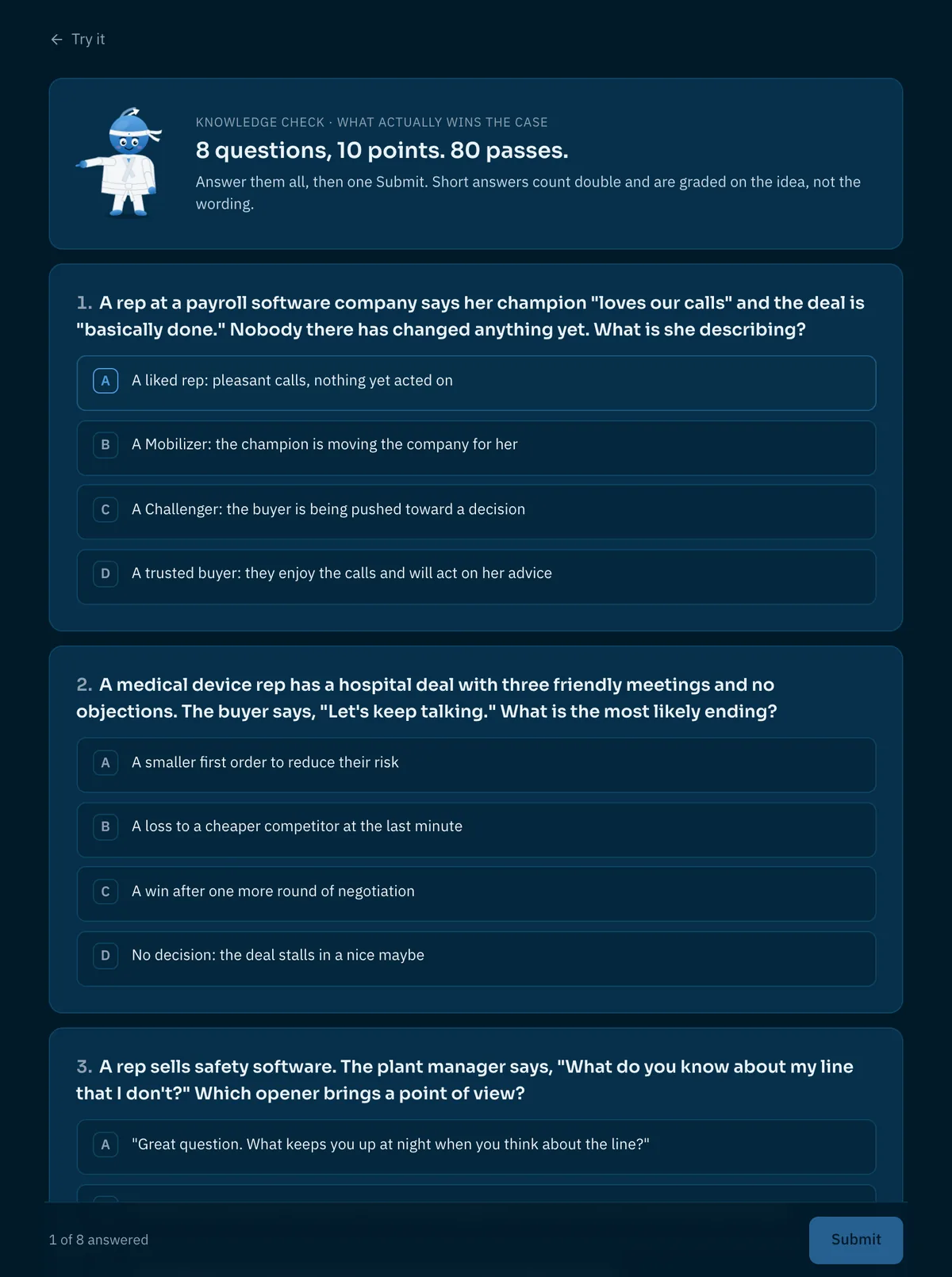
If a rep passes the knowledge checks but still folds on live calls, that's a rehearsal gap — they know it, they haven't practiced it under pressure. If they're failing the knowledge checks themselves, that's a comprehension gap, and no amount of calendar time fixes it on its own.
Where SalesARC fits
A 90-day ramp framework only works if someone is actually watching the right metrics at the right checkpoints, which is the job most founder-led companies don't have any
Related questions
- How long should it realistically take before a new sales hire or sales system starts producing real pipeline?
- How do I design a commission plan for the first few sales reps I hire?
- What does a healthy sales pipeline look like for a company under $10M in revenue?
- How long does it typically take for a new BDR to start booking qualified meetings?