
How many outbound touches does it typically take before a cold B2B prospect responds?
The short answer
Most cold B2B sequences need 8 to 12 touches across email, phone and LinkedIn before a prospect responds, spread over 2 to 3 weeks. A single channel rarely works alone — Brevet Group research puts average cold-call connect rates at just 1 in 8 attempts, which is why multi-channel cadences outperform single-channel ones.
The honest number
There's no single magic touch count, but the range that shows up across sales-engagement research is consistent: 8 to 12 touches, blended across email, phone, and LinkedIn, before a cold prospect responds. The Brevet Group's widely cited sales statistics put the average cold-call connect rate at roughly 1 in 8 dials, meaning a rep working phone alone will burn through a lot of calls before reaching a live person, let alone getting a yes. TOPO's sales development benchmarking has found similar patterns for outbound sequences that mix channels rather than hammering one.
The practical takeaway: if your sequence stops at 3 or 4 touches — which is where most founder-led outbound dies once the founder gets busy — you're quitting before the statistically likely response point. Most replies come from touches 5 through 9, not touches 1 through 3.
Why channel mix matters more than touch count
A 10-touch sequence that's all email behaves very differently from a 10-touch sequence that alternates email, a phone call, and a LinkedIn connection request. Email-only sequences suffer from inbox fatigue and spam filtering; phone-only sequences suffer from the 1-in-8 connect rate noted above. Blending channels gives the prospect multiple low-friction ways to respond, and it signals persistence without feeling like spam — a LinkedIn view followed by an email followed by a short voicemail reads as a human doing their job, not a bot hammering a list.
A reasonable cadence for a $5M–$15M B2B company selling into a single economic buyer looks something like: email day 1, LinkedIn connect day 2, call day 4, email day 7, call day 9, email day 12, breakup email day 18. That's 7 touches over about 2.5 weeks, which lands inside the 8–12 range once you count any voicemail drops.
| Channel | Typical connect/open behavior | Role in the sequence |
|---|---|---|
| Cold call | ~1 in 8 dials connects (Brevet Group) | Highest-signal touch, best for qualifying intent fast |
| Opens vary widely by domain health and subject line | Low-friction, scalable, easiest to automate | |
| No connect rate benchmark as reliable as email/phone | Builds familiarity before the ask, softens cold calls | |
| Voicemail/SMS | Supplemental, rarely the first touch | Reinforces timing around a call attempt |
Where this breaks down
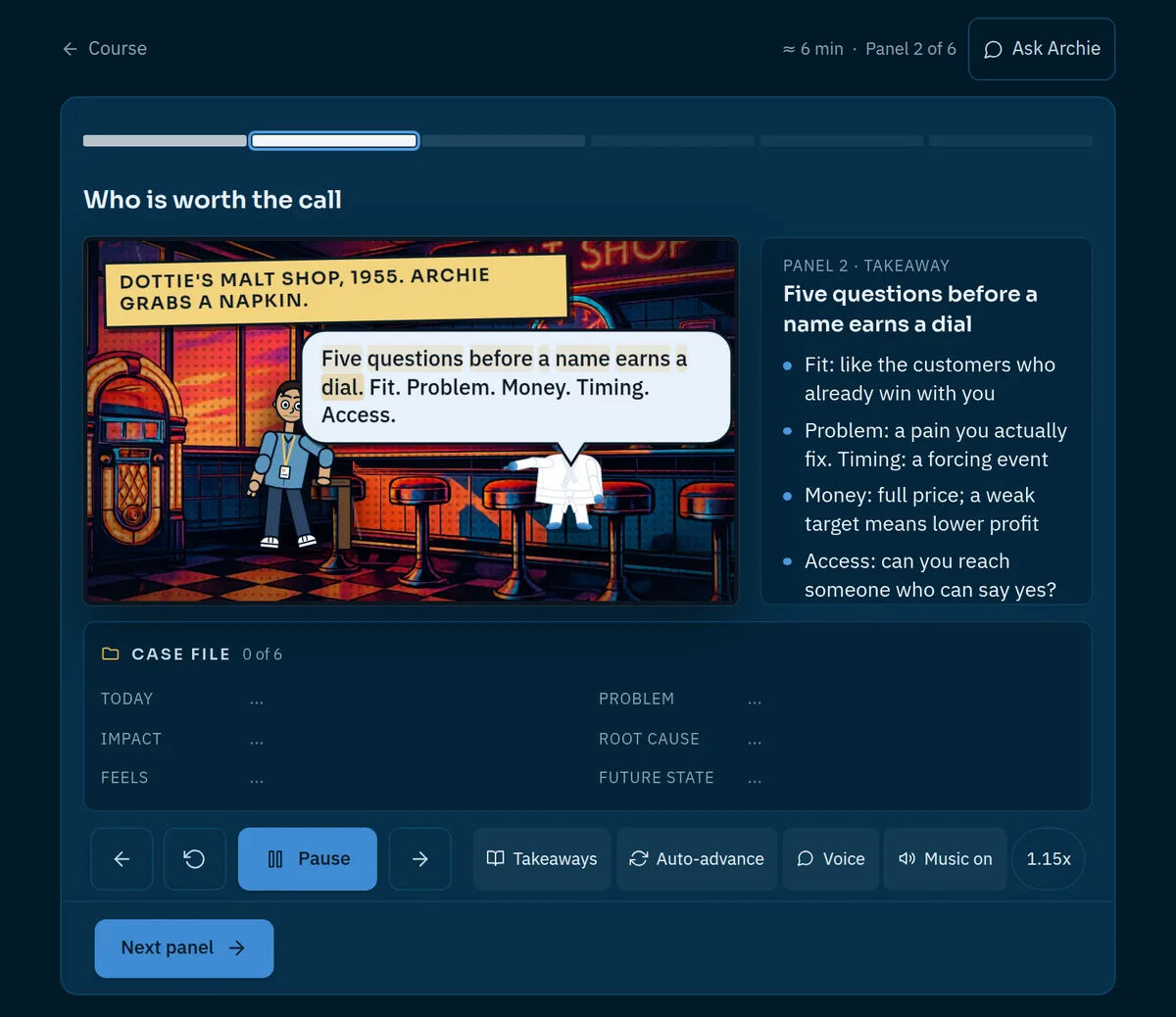
Touch count is a planning heuristic, not a guarantee. A founder-led company with a narrow, well-defined ICP will often get replies faster than this range suggests, because the message is relevant and the list is tight. A company prospecting a broad or poorly defined list will need more touches, or won't get replies at all regardless of sequence length — more touches against the wrong account doesn't fix a targeting problem. If reply rates are low after a full 10-touch sequence, the first thing to check isn't cadence length, it's whether the ICP criteria are actually filtering for fit, problem, money, timing, and access.
It's also worth separating "response" from "qualified meeting." An 8-touch sequence might get a reply on touch 6, but that reply could be a polite no, a forward to someone else, or a "not now." Tracking response rate alone overstates how well a cadence is working; tracking qualified-meeting rate per 100 touches is the number that actually matters for pipeline math.
Where SalesARC fits
SalesARC's ArcClaw™ Prospecting Agents run multi-channel cadences automatically — email, LinkedIn, and call-task sequencing included — so the 8-to-12-touch pattern happens on a schedule instead of depending on a founder remembering to follow up on day 9. Basic tier starts at $499/month for teams that want the cadence running without building it by hand. For companies that want to design and rehearse the actual call scripts and objection responses that make each touch count, that's a Playbook and training question, not just a sequencing one — see SalesARC Prospect.